
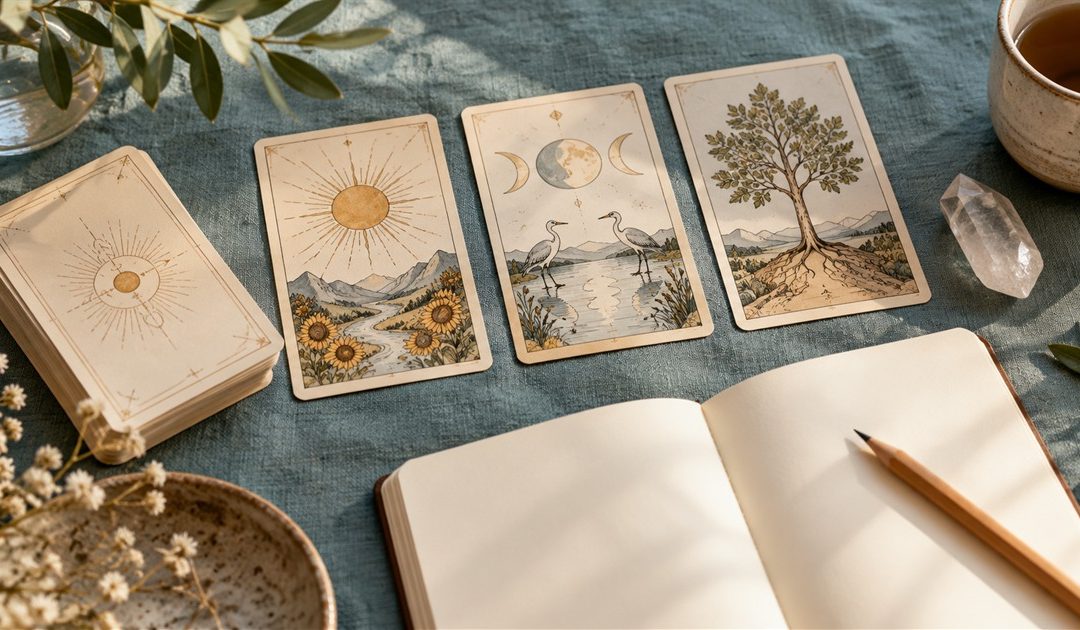
A free tarot reading can be a small pause rather than a purchase. If you already have a deck, you can begin with one card. An online card tool offers another route. The value comes from the question, the image and what you thoughtfully do with the reflection—not from a promise that the cards fix your future.
Choose the kind of free experience you want
A self-guided draw
You choose or randomly draw a card and reflect on it using a guidebook or your own observations.
An online tool
A website selects cards and supplies interpretations. This may be fixed text or an automated response rather than a live reader.
A promotional session
A human reader may be included, but eligibility, payment requirements and time limits can apply. Check the terms.
Do not assume that a tool becomes a personal human reading because it asks for your name. For price differences, see the no-cost vs paid-offer checklist.
Try a one-card reflection
- Write a question about your part in the situation.For example: “What deserves my attention as I prepare for this conversation?”
- Draw one card.Use a deck you already own or a suitable online tool. You do not need to repeat the draw until you like the result.
- Describe the image.Notice a figure, color, movement or contrast before reaching for a prediction.
- Consider one interpretation.Read a guidebook meaning, then ask how it fits—and how it does not fit—your circumstances.
- Choose one practical step.Write a question, prepare a conversation or gather information. The card does not make the decision for you.
For a no-charge online option, PsychicOz’s one-card tool provides a random card and written interpretations. The tool is separate from personal paid readings. Check any optional service’s price before booking; see our affiliate disclosure for commercial relationships.
Want a little more structure?
Use three positions: the situation, what needs attention, and a possible next step. These are prompts, not a guaranteed timeline. Read each card in its position instead of forcing a dramatic story from every image.
For example, a card associated with change might prompt “What am I ready to approach differently?” It does not require an immediate breakup, resignation or expensive new beginning.
Keep a few boundaries around the exercise
- Do not use a draw to diagnose a health condition or decide a legal or financial outcome.
- Keep relationship questions focused on your choices rather than claiming access to someone else’s private thoughts.
- Pause if repeated draws become a search for reassurance.
- Check privacy and payment conditions before entering personal details online.
Our relationship tarot guide offers topic-specific questions. If you prefer a conversation, the beginner’s reading guide helps you compare formats.
Frequently asked questions
1. Can I read tarot without paying for a session?
Yes. Use a deck you already have or a no-charge online card tool for a self-guided reflection.
2. Is a free card tool the same as a live reader?
No. A tool may use random selection and written interpretations without a person responding to your question.
3. Do I need to give my real name?
Many reflective exercises do not need it. Check why a tool asks for identifying information before sharing it.
4. What is a useful first question?
Try a question about your own attention or choices, such as what to consider before a conversation.
5. Should I use one card or three?
One card is a simple starting point. Three positions can add structure when you have a clear question.
6. What can three positions represent?
Try the situation, what needs attention and a possible next step. Treat them as reflective prompts rather than a guaranteed timeline.
7. Do I need to understand every symbol?
No. Begin with what you notice, then consult a guidebook if you want more context.
8. Must I read reversed cards?
No. You can begin with upright cards only. Choose your approach before drawing and use it consistently for that exercise.
9. What if I dislike the card?
Notice the reaction and consider what it brings up. You do not need to redraw until you receive a more reassuring image.
10. Can a difficult card predict a disaster?
Do not treat a card as a guarantee that harm will happen. Consider its symbolism without turning it into a threat.
11. Can cards tell me another person’s private feelings?
They cannot establish those feelings as fact. Focus on your own expectations, communication and boundaries.
12. Can I ask a health question?
A reading is not a diagnosis. Bring health concerns to an appropriate healthcare professional.
13. How do I know whether an online reading is free?
Check payment requirements, limits, optional purchases and any later charges before starting.
14. Does entering an email address cost nothing in every sense?
It may not require money, but it still involves sharing personal information. Check privacy and marketing choices.
15. How often should I draw?
Choose a pace that remains useful. Pause if repeated draws about the same concern leave you more anxious or dependent on reassurance.
16. Should I keep a tarot journal?
You can. Record the question, card, interpretation and a practical next step without rewriting the entry to fit later events.
17. Can I read for a friend?
Ask permission, agree on the topic and avoid claiming hidden facts about them or other people.
18. What should I do after a reading?
Let it settle, keep the ideas that help you reflect and choose a reasonable action based on your actual circumstances.