
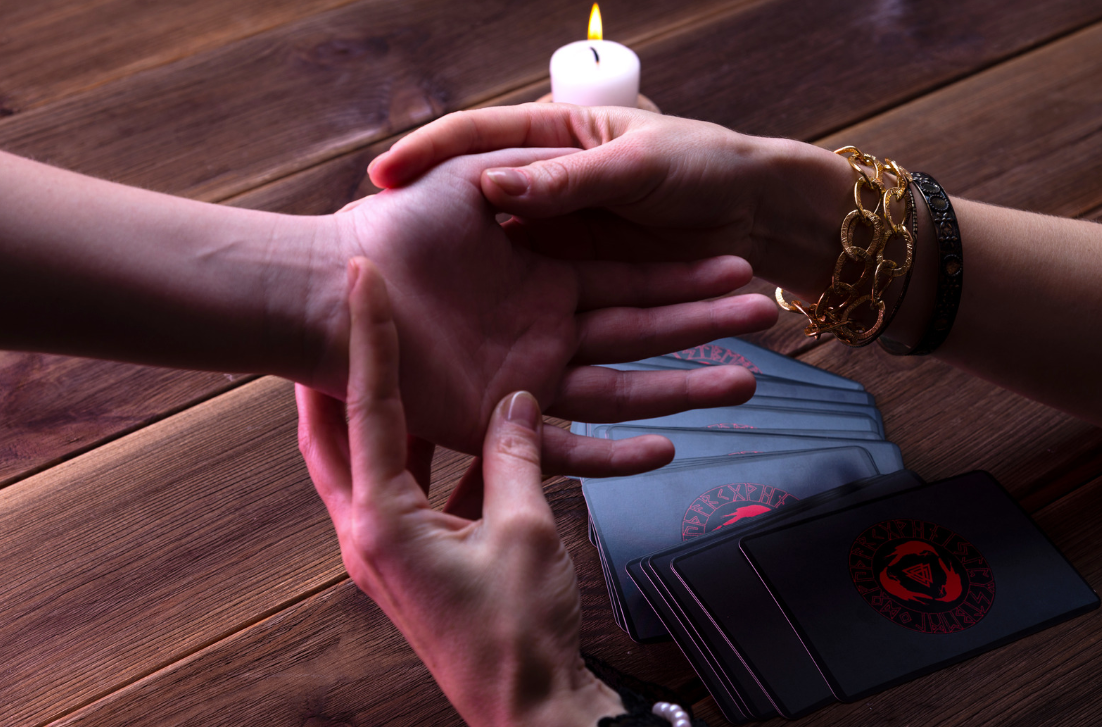
Palmistry, also called chiromancy, reads the hand through a symbolic tradition. The heart, head, life and fate lines are familiar starting points. If you enjoy this practice, use the lines to open questions about your life—not close them with a verdict.
Find the main lines first
Hold your palm comfortably in good light. Lines differ from hand to hand, and you may not see every feature in a diagram. These locations are approximate; there is no need to force your hand to match a textbook illustration.
Heart line
Usually crosses the upper palm beneath the fingers. In many palmistry approaches it is associated with emotional expression and relationships.
Head line
Usually crosses the middle of the palm below the heart line. Traditional readings connect it with approaches to thinking and decisions—not a measured intelligence score.
Life line
Usually curves around the base of the thumb. Readers may discuss vitality or life patterns symbolically. It cannot tell you how long you will live.
Fate line
Often described as a more vertical line through the center of the palm. It is associated with direction or work in some systems, and may be faint or absent.
Turn a traditional meaning into a useful question
Instead of treating a curved heart line as proof of a particular personality, ask, “How do I show care, and what helps me receive it?” A head-line discussion might lead to “When do I deliberate, and when do I decide quickly?”
The life line can prompt reflection on routines that support you. The fate line can open a conversation about commitments and changes in direction. These questions remain useful even if a description does not fit your hand.
Which hand should a reader use?
Approaches differ. Some readers compare both hands or distinguish the dominant hand from the other. Ask what convention your reader uses rather than assuming one hand reveals an unchangeable destiny and the other reveals your current life.
Historical books such as Cheiro’s Palmistry for All show how elaborate these systems can become. They are sources for the tradition’s ideas, not modern evidence for medical or predictive claims.
What a line cannot establish
- Your lifespan or a medical diagnosis.
- How intelligent, honest or worthy you are.
- Whether a partner is faithful or a marriage will last.
- A fixed number of children, marriages or future successes.
Do not use a partner’s palm as a substitute for getting to know them. A relationship is shaped by communication, consent and behavior, not a mark beneath the little finger.
Try a simple reflective reading
- Choose one line.Describe what you can actually see before adding an interpretation.
- Choose one theme.Use a question about emotions, decisions, support or direction.
- Check the fit.Keep what helps you reflect and leave the rest. No line obliges you to accept a story about yourself.
To compare this approach with cards and intuitive sessions, visit our reading-style guide. For relationship reflection, try questions you can bring to a tarot spread.
Frequently asked questions
1. What are the four main palm lines?
Common starting points are the heart, head, life and fate lines. Naming and interpretation can vary between palmistry systems.
2. Where is the heart line?
It usually runs across the upper palm beneath the fingers. Hands differ, so diagrams are approximate guides.
3. Where is the head line?
It usually crosses the middle of the palm below the heart line.
4. Where is the life line?
It usually curves around the base of the thumb. Its name does not make it a measure of lifespan.
5. Where is the fate line?
It is commonly described as a more vertical line through the center of the palm. It may be faint or absent.
6. Does a short life line mean a short life?
No. Do not use a palm line to estimate lifespan or assess your health.
7. Does a long head line mean high intelligence?
No. A palm line is not an intelligence test. You can use the traditional theme to reflect on your decision-making style.
8. Can the heart line reveal someone’s feelings for me?
No. It cannot establish another person’s private thoughts. Communication and behavior provide more useful relationship information.
9. Can palmistry predict a breakup?
A mark or branch cannot establish that a breakup will happen. Avoid making a relationship decision on that basis.
10. Which hand should I read?
Different approaches use different conventions. Some readers compare both hands or distinguish the dominant hand from the other.
11. What if I cannot find a fate line?
You do not need every named line for a reflective exercise. A faint or absent line does not mean you lack purpose.
12. Can a palm reader diagnose illness?
Do not use palmistry for diagnosis. Take symptoms or health concerns to an appropriate healthcare professional.
13. Do all palmistry books agree?
No. Conventions and interpretations differ, and historical texts may contain claims that should not be treated as modern evidence.
14. Should I upload a photograph of my hand?
Check where the image will be stored and who can access it. Avoid including faces, documents or other identifying details you do not want to share.
15. What is a useful question for a palm reading?
Ask about a theme you can reflect on, such as how you express care, approach decisions or support your own goals.
This article provides a good overview of palmistry, but it lacks depth. For those interested in learning more, I recommend checking out historical texts or academic studies that delve deeper into the subject.
Haha Reid! Imagine swiping left or right based on heart line readings instead of personality compatibility!
Ha! Yeah James, at least fortune cookies come with a snack! Let’s keep the deep life lessons for after dessert!
@James Nicole You’re absolutely right! It’s hilarious how people read so much into something so trivial. Maybe they should try fortune cookies instead!
#TruthBomb Walker! It’s amusing how some people treat this as an exact science when it’s far from it.
*Sigh* Walker, you’re missing the point! It’s not about taking everything literally; it’s about introspection and understanding oneself better!