

A connection can feel unusually familiar, intense or spiritually meaningful. Some people use “twin flame” to describe that experience. You can explore the idea while remembering that the relationship still involves two people, each with a right to choose.
What the twin-flame idea describes
In some modern spiritual teachings, twin flames are understood as a shared soul or a powerful mirror for growth. Other people use the phrase more loosely for a transformative bond. There is no single agreed definition or reliable test that identifies a particular person as your twin flame.
A label can express meaning. It cannot establish what another person feels, require a relationship or guarantee that separation will end in reunion.
LGBTQ+ connections belong in the conversation
If you use twin flame to describe a bond, the people involved do not need to be a man and a woman. A connection can feel spiritually significant between people of the same gender, different genders or outside a binary account of gender. It can also remain a friendship if that is what both people want.
Some teachings speak of masculine and feminine energies. You can interpret these as optional symbolic qualities rather than rules about bodies, identity, attraction or who must lead a relationship. Nobody needs to perform an assigned role to make a bond spiritually valid. Your orientation and gender are not things a reading can determine for you.
The word inclusive does not mean boundary-free. Each person’s privacy, pace and consent still matter. A spiritual story never turns friendship into romantic permission or obliges someone to adopt a label they do not use.
Community pressures are not proof of a destined bond
Some LGBTQ+ people face family rejection, stigma or pressure to hide; others have strong support. Those experiences do not follow one universal script. Disapproval does not prove that a particular couple must stay together, and acceptance is not something you can guarantee by being brave enough or explaining your connection perfectly.
You decide when and with whom to share personal information. The Human Rights Campaign’s discussion of visibility emphasizes choice and safety rather than a duty to come out. Seek people who respect your identity and boundaries, including a reader who protects private information and welcomes the words you use for yourself.
People draw on many traditions when talking about souls and love. Be cautious about a claim that all ancient cultures taught the same modern twin-flame system. A meaningful interpretation does not need an invented universal history to matter to you.
Free connection-and-choice reflection card
- The meaning: What does this connection mean to me?
- The facts: What has the other person actually communicated or done?
- The boundary: What do we each want to protect or decline?
- The support: Who can I speak with without being pressured or outed?
- The next choice: What small step respects both people, including a pause or no contact?
Example: “I feel a deep bond, and they want friendship. I can decide whether friendship works for me without treating their answer as a hidden romantic promise.” Keep notes private if you use them.
Growth can mean acceptance, support or a different direction
You may learn to name a fear, seek appropriate help, accept yourself more fully or build a spiritual practice you enjoy. None of those changes requires a dramatic relationship or guarantees that someone will choose you. Another person’s harm is not a lesson you caused or must complete.
A relationship can be an important part of your story without becoming its entire purpose. Friendship, chosen family, community and life beyond the bond can also support the person you want to be.
Intensity is not the same as compatibility
Strong attraction can make a connection memorable. To understand whether it works in daily life, look at more ordinary questions: do you communicate honestly, respect limits and follow through on agreements? Can each person disagree without being punished?
A calm relationship is not spiritually inferior because it lacks drama. Conflict, uncertainty and repeated hurt are not requirements for a deep bond.
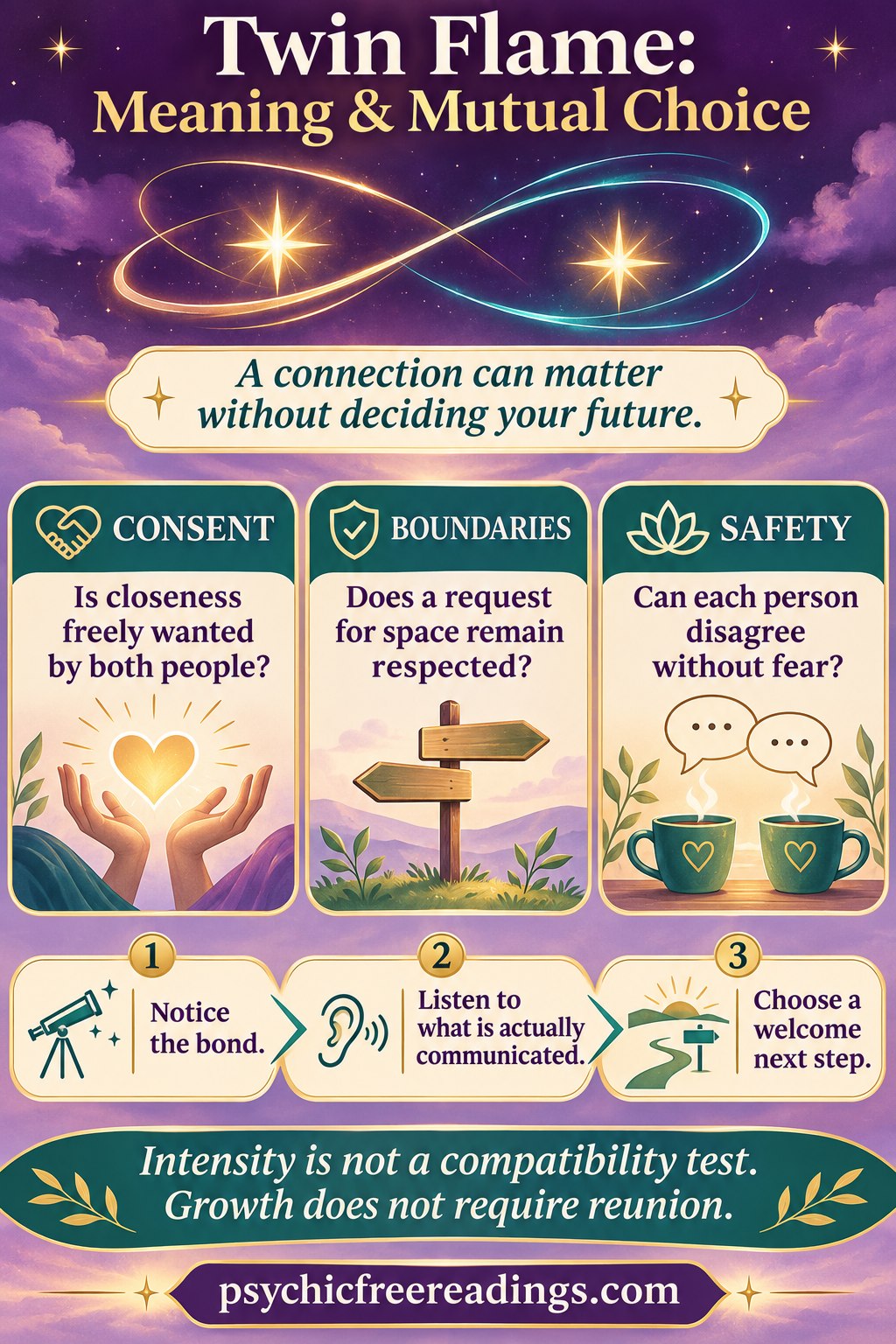
Three things the label should never override
- Consent: closeness must be wanted by both people.
- Boundaries: a request for space or no contact still counts.
- Safety: threats, coercion and controlling behavior are not spiritual lessons you must accept.
Reconsider “runner and chaser” language
Some twin-flame stories describe one person withdrawing while another pursues. Be careful when that story turns a clear refusal into a supposed invitation to try harder. Someone who does not want contact is not giving consent through a spiritual role.
If you are the person wanting distance, you do not have to prove that the connection is false before setting a boundary. If you want closeness, you can grieve the difference without pursuing someone who has said no.
Growth can happen without reunion
A meaningful relationship may prompt you to understand a pattern, name a need or reconsider your priorities. That growth does not depend on the other person returning. Nor does continued separation mean you failed to heal, raise your vibration or become worthy of love.
For a related perspective, read spiritual growth and the hope for a soulmate. If both people want friendship rather than romance, explore a platonic connection and its boundaries.

Use spiritual reflection to support your choices
You might journal about what the relationship has taught you. Separate what you know from what you hope: “They asked for space” is information; “They will return after awakening” is an expectation.
A tarot reading or intuitive conversation may offer prompts. It cannot certify that a particular person belongs to you. Avoid anyone who promises reunion, demands repeated payments or tells you to disregard trusted support.
When the relationship feels harmful
You can seek help without resolving the spiritual label first. Love is respect’s boundary guidance emphasizes being able to express needs and limits without fear of a partner’s response. If you feel unsafe, use appropriate local support or emergency help.
A deep connection should not cost you your right to say no. For broader relationship reflection, see finding healthier relationships.
Frequently asked questions
1. What is a twin flame?
It is a spiritual term that some people use for a powerful, transformative bond. Definitions vary; the label does not establish a relationship as fact.
2. Can I prove someone is my twin flame?
There is no reliable test that identifies a particular person as your twin flame. Consider the actual relationship as well as its personal meaning.
3. Does intense attraction prove the connection?
No. Attraction can feel significant without establishing compatibility, commitment or a spiritual identity.
4. Are twin flames guaranteed to reunite?
No. Each person has choices, and a future reunion cannot be promised.
5. Is repeated conflict a necessary stage?
No. Chaos and hurt are not requirements for a meaningful relationship.
6. What does runner and chaser mean?
Some teachings use those roles for withdrawal and pursuit. The story must not override a refusal or request for no contact.
7. Should I contact someone who asked for space?
Respect the boundary they communicated. A spiritual interpretation is not permission to disregard it.
8. Can a twin-flame connection be a friendship?
You can understand a bond spiritually and choose friendship if both people genuinely want that arrangement.
9. Do I need to become perfect before finding love?
No. Personal growth is worthwhile, but you do not need perfection to deserve care and respect.
10. Does separation mean my vibration is too low?
No. Separation does not establish a spiritual failure or determine your worth.
11. Can a psychic guarantee that this person will return?
No. A reader cannot guarantee another person’s feelings, consent or future choices.
12. Should I stay if the relationship feels unsafe?
A spiritual label does not require accepting threats, coercion or controlling behavior. Seek appropriate support when you feel unsafe.
13. Can I learn from the relationship without reuniting?
Yes. You can reflect on your needs and patterns while accepting that the relationship may not resume.
14. What can I journal about?
Separate observable events, your hopes, your boundaries and one practical action you can choose.
15. Can I stop using the twin-flame label?
Yes. You can change the language you use for an experience without denying that it mattered to you.
16. Can twin flames be people of the same gender?
If that spiritual language fits your beliefs, you can use it for a same-gender connection. The label still cannot establish another person’s feelings or consent.
17. Must one partner have masculine energy and the other feminine energy?
No. Those are optional symbolic ideas, not required gender roles or a test that validates a relationship.
18. Do I need to come out to honor the connection?
No. Disclosure is your choice. Consider privacy, support and safety rather than treating public visibility as a spiritual obligation.
While I appreciate the attempt to romanticize chaos and twin flames, I found the content overly idealistic. Life’s challenges are not always meant to lead us to spiritual awakenings or perfect relationships. It’s just not that simple.
“This idea of twin flames feels so overhyped at times! Yes, growth can come from chaos, but let’s not forget that some people simply need stable relationships without the drama!”
The concept of twin flames is fascinating and quite complex. Many people may not realize that these connections often involve significant personal growth, which can be painful but ultimately rewarding. Understanding this dynamic can help people navigate their relationships better.
Interesting perspective! However, I think it oversimplifies what many go through in relationships. Not everyone will have a ‘twin flame’ experience, and expecting this might lead to disappointment.
‘Twin flames’ sounds like an excuse for toxic behavior in relationships! Just because someone triggers you doesn’t mean they’re your destined partner; it could just be unhealthy dynamics at play!
‘Twin flames’ as a concept seems more like a marketing ploy for self-help than a genuine phenomenon. Real-life relationships require work and communication, not just spiritual awakenings and cosmic timing.